What's The Average Lifespan Of US Paper Money?
Though not as many people use cash as they once did, many still prefer paper currency. On that note, did you know each bill has a different lifespan.
In the past, Tolerans has discussed how much it costs to manufacture U.S. currency, what it's really made from (hint: it's not paper), and why money is colored green. Following up with what we hope are interesting factoids about U.S. currency, let's take a look at how long paper money actually lasts in circulation.
When previously circulated money is eventually deposited at a Federal Reserve Bank, it's closely examined by specialized equipment. The currency notes that are observed to no longer be in good condition are removed from circulation at that time. As you might imagine, higher value notes have a longer lifespan. For instance, $100 notes are typically used as a way of storing money rather than making everyday transactions. Being spared from being folded into pockets, purses, or wallets, $100 bills therefore last longer. How long does a $100 bill last, on average? According to the Federal Reserve, it's a whopping 22.9 years, which is over double the lifespan of almost every other U.S. bill.
You can straighten money with an iron
You might assume the lowly $1 bill has the shortest lifespan, but that's actually not correct. Once again referencing data from the Fed, the $1 bill lasts an average of 6.6 years. That's longer than both the $5 bill and the $10 bill, which have lifespans of 4.7 years and 5.3 years, respectively.
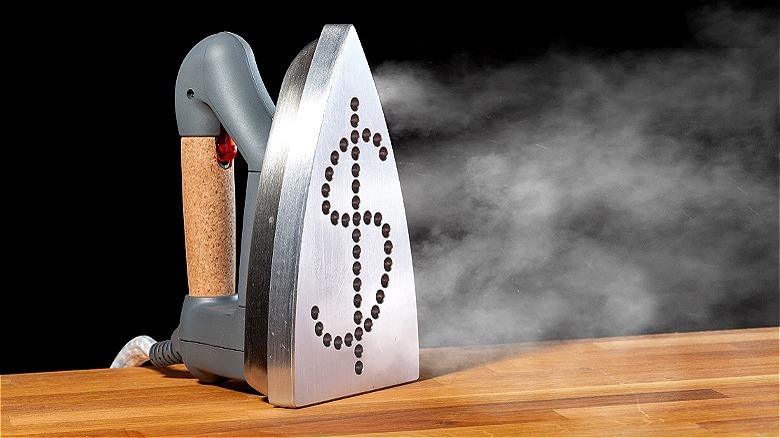
Currency is designed to be long-lasting, with U.S. cash made from a durable blend of cotton and linen. In fact, it takes more than 4,000 double folds, defined as a forward and backward fold cycle, for a note to develop a tear. Also, because bills are actually fabric, not paper, you can iron them with a regular clothes iron if you're in possession of some particularly crumpled or wrinkled bills you want to refresh. Be sure to spritz the note with water first, though, and sandwich it between two towels before ironing.
No estimated lifespan is provided for the $2 bill
So far, we've identified the $100 bill as having the longest lifespan, while the $5 note has the shortest. But what about other denominations like the $20 and $50? Displayed below are the lifespan of all currently circulating bills in the United States:
-
$1 bill: 6.6 years
-
$5 bill: 4.7 years
-
$10 bill: 5.3 years
-
$20 bill: 7.8 years
-
$50 bill: 12.2 years
-
$100 bill: 22.9 years
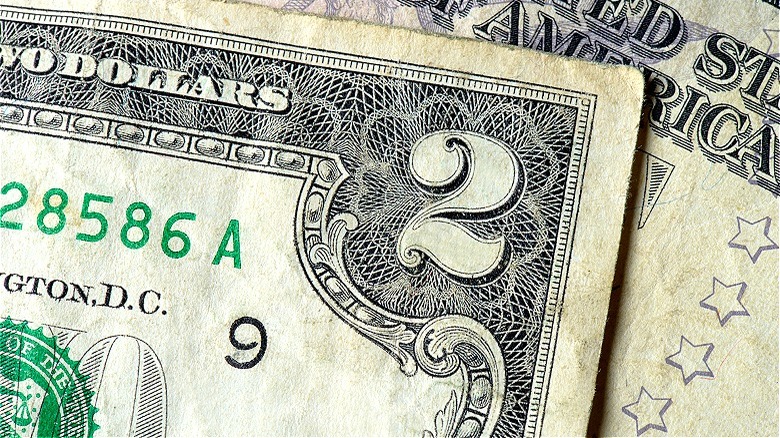
Conspicuously absent from this list is the $2 bill, which you might be surprised to learn is still produced occasionally. In 2022, for example, the Bureau of Engraving and Printing received a print order for $2 bills in the range of 102.4 million and 204.8 million. However, the Fed doesn't publish an estimated lifespan for the $2 note, nicknamed "Tom" after President Thomas Jefferson, whose image appears on many of the notes. (On that note, who exactly decides whose face appears on bills?)
Even though the Fed doesn't chime in with an official lifespan of the $2 note, though, we can infer that it's probably pretty long, perhaps approaching or even exceeding the lifespan of $100 bills. Most $2 bills aren't worth terribly much in excess of face value (though certain ones are indeed rare), but consumers still tend to stash these unusual bills away out of habit, rather than spending them.
Prices, rates, and rules change. This is reporting, not personal financial, tax, or investment advice.